Search This Blog

Monday, April 1, 2024

Saturday, January 8, 2022

A Day in the Life (Winter)

 I wake each morning at 7am and turn on my blue LED solar/battery powered lights. It's usually around 50 degrees Fahrenheit (10 degrees Celsius) in my cabin in the mornings. I get dressed, make a pot of tea, and sometimes make pancakes. By 8:30 I'm ready to drive to work. To get to my driveway it takes a headlamp, snowshoes, and sometimes bear bells to let the moose know I'm coming. My cabin is about nine stories up a hill and I usually bring my pack frame backpack to the bottom of the hill a few times a week to haul firewood back up after work.


I scrape the ice off my car windows and sometimes dig out my car from a fresh snowfall. By 9am I'm at work in the boatyard and get home a little after 5 in the afternoon. This time a year it's dark at both ends of the day so I drive to and from work in a dark twilight. Homer gets about six hours of daylight in December. 


After work I sometimes dig out my driveway again before I can park, load up my backpack with chopped wood, and haul it up the hill. It takes about three minutes to climb the hill with a full pack. 


By the time I get home it's about 40 degrees in my cabin so I light a fire in my wood stove, make dinner, clean my dishes with melted snow, and go to bed sometime after the temperature reaches 70 degrees. 


Sunday, October 24, 2021

Back in Alaska-a Brief Update

I flew out of Australia in mid March of 2020. It was one of the last flights out before the borders closed. I was signed up for vocational school starting in April, but since 2020 didn't go as planned, school was pushed back to July. Once it finally started I graduated six months later with a certificate in Marine Systems from the Northwest School of Wooden Boat Building. I was immediately hired as a diesel mechanic for a boat shop in Port Townsend, Washington. I worked there for eight months then was offered a job in Homer, Alaska. Home! I took the job and within six weeks I'd sold my boat, quit my job, and drove to Alaska in my sister's Grand Marquis. 

Over the past five weeks I've been working for a fiberglass boat builder. I've been sanding boats, designing an battery system, and learning to make resin-infused fiberglass panels. It's a great job and I'm really enjoying myself.

I've moved back into my little cabin in Homer and I'm currently house- and dog-sitting for my cousin.

Masking and sanding of the "John Hunter"


Resin-infused panel

Dog-sitting


Home, sweet home

Monday, April 6, 2020

Overland Track, Tasmania

In the last month I've planted a garden, fixed a very large fence, pulled out every blackberry root that I could find within spitting distance, and tuned a ukulele.  Now to catch up on my neglected blog.


Friday 7 February 2020
Day 1
Alex and Cradle Mountain

Megan and Alex's finger

Alex and I started walking from the north end of Dove Lake in Tasmania with an 18-20kg (40-44lbs) pack each. We packed for six days, but predicted that we'd cover the 65kms (40mi) Overland Track in four or five days (it didn't happen.) We followed the Eastern Track to the first shelter hut. We though we'd skip a few shelter cabins along the way because they were so close together and our combined marathon training made longer distances possible (a 40+lb pack isn't part of our regular distance training.) We left from the bus drop-off station just before 10am and made it the first shelter cabin at 3pm. We covered eight kilometers (5 mi) in five hours.

Top half of the map I carried

Our time on the trail was lengthened by the track unexpectedly climbing over the top of Hanson's Peak which summited at 1185m (3888ft.) The trail was lined with metal posts embedded into the face of the mountain and connected by chains so hikers could pull themselves up. Alex led the way and for about half an hour and I looked up at the soles of his shoes as we pulled ourselves up the the bouldered face.
Post and chain hike to Hanson's Peak

It was noon when we sat down for lunch near the summit. I dropped my pack and ran to the top for a quick reconnaissance. It was entirely downhill to the shelter cabin from there so we continued around the base of Cradle Mountain to the Scott-Kilvert hut. The S-K hut is not usually frequented by the Overland Track hikers. The Waterfall Valley hut which is usually the first stop was under construction for the season so everyone was diverted off the main trail down into a very steep valley for alternative shelter. We took the Eastern Track because we didn't want to hike the steep trail twice. We were the first hikers to the hut that day. There is a quota of daily hikers and groups travel roughtly together for a majority of the track. From the reports of the hikers who arrived later we were glad we didn't need to hike down several hundred feet of steep, wet trail at the end of the first day. There was every combination of tears, rage, and bewilderment for such a terrible detour. Even with the hike over Hanson's Peak we were convinced we took the best trail.

I finished my day by jumping into a lake near the hut and starting my wash-and-dry rotation of underwear and socks.

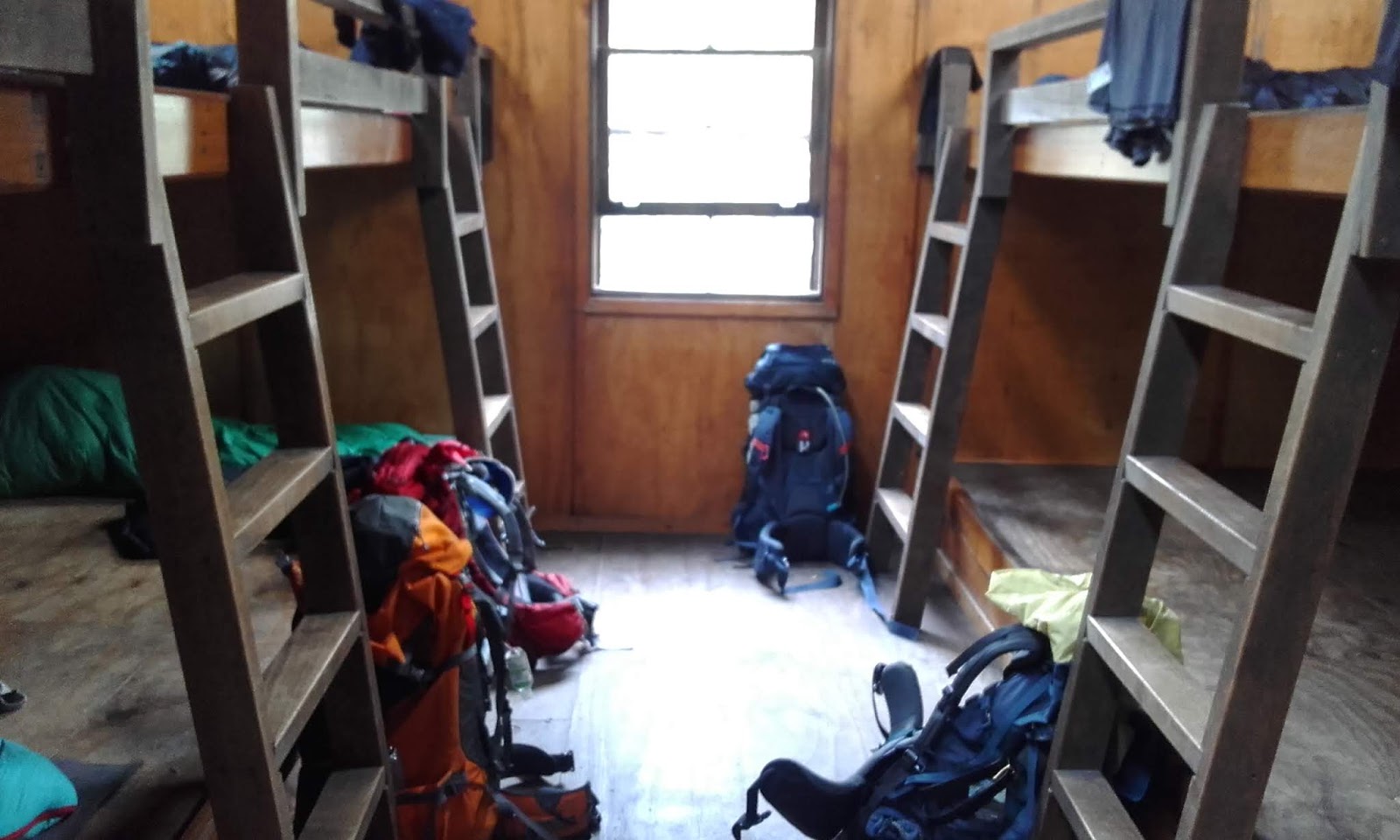
Scott-Kilvert Hut with underwear hanging out the window

Saturday 8 February
Day 2
The dreaded hike out. Alex and I decided an early start would be best for us. There were a dozen or so hikers in the S-K hut that night and we didn't want to be playing leap frog on a narrow trail all day. We were awake and on the trail before the fog cleared from the valley. By the time we climbed up to the plateau from whence our fellow hikers descended the sun had burned off the fog.

Cradle Mountain from the S-K area valley floor

When I was in grade school I read a book called Holes by Louis Sachar. In it was a conversation between two boys who were interned at a disciplinary "camp" which required them to dig holes all day. The first said, "The first day is the worst." The second replied, "No the second day is the worst because you're already tired and have blisters before even starting." Not quite verbatim, but that's the gist.

Our second day was easily the hardest. It was 12-kilometers of undulating plateau beginning with a 2km slippery clilmb out of the S-K valley. I had blisters on the backs of my heels and could feel a few more starting on my big toes. Bandages and medical tape patched the tender spots which made all the difference in the days to come. (A fellow hiker lost a couple toe nails on the third day and when we saw her on the 6th she said she hadn't even looked at her feet since a fellow MD hiker taped them up.)

After the first day we redistributed equipment, dumped excess water, and felt better about the terraine. Even so, covering the distance while carrying heavy packs and the lack of shelter from the sun made for a long and sun-scorched afternoon. We walked slower as the day went on and were passed by several other hikers.

A couple hundred feet before reaching the second hut we came across another lake. I was overheating and my shoulders were getting a stiff so I dropped my gear and jumped into the lake before finishing the day. A fellow swimmer and I even convinced Alex to wade in for a few minutes. Cool water on a sun-burned body makes for a much easier battle with seizing muscles. We arrived at the second shelter cabin (Windermere hut) at 4:20pm.

At this point Alex was having trouble with his backpack. It didn't fit very well and he was carrying a little too much gear to continue walking comfortably. After talking with the semi-permenant resident Ranger Matt and several of our fellow hikers we were able to get his pack adjusted and some gear distributed to volunteers who would leave it at various huts over the following days. We put the water bottles on the outside pockets of my pack for easy access. There was reluctant talk of hiking back out, but we were so far along not just in hiking, but logistically that turning back would become more difficult that continuing forward. Another possiblity would be to take the next section of 17 kms (10.5mi) in two parts by camping half way to the next hut. I was relucant to slow down also because I had food for six days and staying out longer would force me to ration which turns recreation into survival and really sucks the fun out of camping.

I saw an echidna! 'Twas the highlight of my day. Camera was packed tightly away in pack so here's a portrait of another trail mate.

Local friend
Sunday 9 February
Day 3
We started early again. The sky was clear and other than a small grassy open area we were sheltered by forrest cover for the whole day. The terrain was mostly duck boards (planks laid by the park servcies to protect the vegetation) and well-groomed flat trails. The dreaded Frog Valley which looked steep on the map was actually long and gradual so the slope was barely noticable. We finished the 17km day with minimal stops at 2:35pm. Pelion Hut could house 35+ people comfortably plus there were several camping platforms outside. There were many more hikers there than at the previous two huts. Pelion hut lies at the middle point of the Overland Track and is a one-day hike to a road and trailhead to the east. People often hike one day in and back out so the largest cabin was situated here.

Mount Oakleigh, visible from Pelion Hut

Wallabys, wombats, snakes, and lizards live in the flatlands below the mountain. They were mostly visible at dawn and dusk.

Monday 10 February
Day 4
Kia Ora hut was 8km along the track from Penion hut; four kilometers up a saddle and four down the other side. At the top of the saddle we could see Mount Ossa, the highest point in Tasmania. On a better day I may have taken the time to climb her, but the clouds were coming in and rain was predicted. We learned later that several people who climbed it reached the top in clouds.

Kia Ora Hut, giant bunks!
Middle section of track

We were glad we started early. Water had run along the trail recently and washed away the dirt leaving boulders and uneven ankle-breaking rubble. We arrived at Kia Ora Hut by noon and actually crossed paths with a few hikers who were a day ahead of us and hadn't left yet. Several people who were keeping pace with us decided to continue on to the next hut. We decided to take the day and relax. There was a very cold creek nearby that I jumped into. Altitude was made evident by temperature. My legs were feeling strong and the blisters were under control, but I'm alway suspicious when things are going too well.

Taking a break at the top of the pass

Mount Ossa, the highest peak in Tasmania
Tuesday 11 February
Day 5
Ten kilometers over the final pass and it was down hill from there! The rain never came, but mist and the threat of rain lingered overhead. I took the opportunity to take a side trip to D'Alton Falls. Alex continued on while I left my gear beside the trail and climbed down the small valley (with PLB, map, and whistle) to see the falls. I caught up with Alex a couple hours later and we arrived at the Burt Nichols hut just before 1pm
D'Alton Falls

Most of the day's hiking was on narrow trails amont chest-high thick brush. The Alaskan in my was thinking about bears all day. They would love this terrain. I'm always relieved to know that Tasmania does not have terrestrial carnivorous predators big enough to take down an adult human. The Tasmania Devils will likely make off with an unattended sandwich given the opportunity.

Wednesday 12 February
Day 6
Narcissus hut was the last on the trail. It was ten kilometers of downhill easy walking all the way to the north end of Lake Saint Clair. We made it by 11am and felt like the day hadn't even started. I jumped into a slough near the edge of the lake then quickly back out when someone mentioned leeches.

Alex on the home stretch

Megan day-dreaming of steak
Bridge!

Laundry day

There was a radio in Narcissus hut used to call a ferry to arrange a ride to the visitors center at the south end of lake. Alex called and arranged two seats for the next ferry which wouldn't be until the next day. After washing all my clothes in Leech Slough, having lunch, and tea it was barely noon and we had 21 hours to wait for the ferry. I looked at the map and about 20 minutes later was repacked and left to hike the 16km length of Lake St. Clair to the campground at the visitors center. Alex took most of the remain cooking fuel, snacks, clothing, and extra water bottles. I carried as little as I could with the contigency plan of camping out along the lakeside.

Final section of Overland Track and Lake St. Clair

This final section of the track was the least-traveled and in the worst condition by far. Several trees were down across the trail, large sections were washed out or saturated with deep mud, and I saw more snakes in those five hours than the rest of the entire track. I passed two other hikers and other than that I was in my own company for 4.5 hours until I reached the visitors center at 6:02pm that night.

The trail was challenging and by the end I was walking very slowly and pulling myself along with my treking poles. I covered 26km (16 mi) with a 16kg (35lb) pack. The visitors center was expectedly closed by the time I got there, but the restaurant was open. I left my gear outside in a "gear area" and bought myself a Dark Ale local brew. I talked with someone who introduced himself as the Michael the owner and I asked if there was a way to contact Narcissus hut. Michael was also the ferry driver who operated the other end of the Narcissus hut radio so he called up the lake and told Alex that I was enjoying a beer in the bar.

Early morning on Lake Saint Clair waiting for Alex's ferry

Michael picked up Alex the next morning and I met them dockside. Alex and I decided to drive to Ouse (closest grocery store) to buy steaks and he cooked dinner at our friend John's cabin on Dee Lagoon about an hour from Lake St. Clair.

Thursday, December 26, 2019

Back in Auckland

I visited Auckland briefly in late 2014. I had just enough time to buy a bicycle and set it up before pedaling south. I finished the ride five weeks later in Christchurch where I flew to visit Austalia for the first time. Now in late 2019 I am visiting a taking the time to see the city.

I left Sydney last night and arrived at 1am at the Auckland International airport. Buses and trains to the city didn't start running until 5am so I slept on a bench while one obnoxious fly kept crawling up my pant leg. At 4:30am I went to look for the bus station and along the way found (strategically placed I'm sure) a Sky Bus; a relatively inexpensive direct ride to the city that runs 24 hours a day. Lucky me. I was the only person on the bus so the driver offered to let me know which stop in the city to get off at. We drove the bus circuit through the CBD and picked up several airport-bound passengers. As we were getting on the highway heading back to the airport I realized I missed something. The driver was very apologetic and even though I told her how much I enjoyed the tour of the city she gave me a voucher for my return trip to the airport next week. I disembarked at my stop over two hours after boarding.

I found the hostel where I was staying, crawled into a top bunk in my shared room, and slept for a few hours.

As my first day playing tourist in Auckland I took myself to the New Zealand Maritime Museum. The exhibits were set up roughly chronologically beginning with early South Pacific canoes and ending with a modern racing yacht  that only fit into the building because more than half the mast had snapped off. I noticed about 100 years of history was missing from the timeline. Roughtly 1775-1860. Colonization was in full swing I know, but in the next few days I'd like to find a reliable account of the specifics.

There was one boat that I fell in love with. I took several pictures then came back and took more. She's called the Rewa.


Saturday, November 9, 2019

Queenstown, Tasmania

I rode into Queenstown from Tullah on Friday, November 8th. The weather has been cold and wet and with my hiking reservation for the Overland Track getting closer I decided to skip Rosebery, Zeehan, and Strahan. I'm a bit bummed because I haven't actually gotten to the west coast of Tasmania yet, but priorities were set long ago.

Alex is planning on meeting me at Lake Saint Clair to hike the 65-kilometer Overland Track. Nasty weather is consistent across the state so we're preparing for everything cold and wet.

I grew up in the Cold so I can manage that. The Wet is my Achilles heel. The ride from Tullah was undertaken with full knowledge that I'd likely encounter snow. I could see the snow line above me on the hill sides as I approched the alpine Lake Plimsoll. I wore all my waterproof layers and used the mantra of "Keep Moving to Keep Warm." I stopped for brief snack and water breaks,  but never for more than a few minutes. At the highest altitude of riding through the hills I was pelted by hail for two hours. Most traffic stopped and I passed them by as the road slowly disappeared under a layer of tiny ice balls. The hail fell so hard that my nose was chafed and my bike bell kept ringing from the constant pelting. My hands and feet were numb for most of the day. I could move them enough to pedal and change gears.

Two cars stopped to offer me a ride and two more coming from the opposite direction stopped to warn me of large semi trucks moving up the pass. In my experience the greatest danger of travel is solitude. Even when everything is going to hell, if people are around there's hope and help.

In Queenstown I stopped by the Information Center and was directed to a nearby hotel with backpacker accommodation. While waiting for a room I stood in front of the only heater in the hotel pub and drank a cider while the feeling in my feet slowly returned.

After stripping for a warm shower I realized that my rain coat had a few leaks. The zipper and all the seem let in moisture,  plus water wicked up my sleeve from my gloves. My sweater was drenched,  but my under layer, a marino wool shirt from a second hand store in Sydney, was warm and dry. A few more hours of riding and my inner layers may have gotten wet.

By chance I came across a store in Q-town that sold ponchos. I bought the most visible which was red. As I was buying it the clerk called me "Red Riding Hood." Appropriate.

Wednesday, November 6, 2019

Chasing Rain

Weather has been rainy, windy, and cold. Lightning appears overhead a few times each day and snow showed up last night on the mountain tops around Tullah, Tasmania.

I rode 45 miles from Devonport to Wynyard on the first day and had a very cold night in my tent. I bought a pink wool blanket from a second hand shop and decided to avoid the questionable dirt roads of the west coast and ride south instead. After a couple days of riding and a couple more cold nights I'm in Tullah, replanning again. In the land of the Roaring 40's, weather is unpredictable. This morning had a lightning storm and this afternoon had hail. Tomorrow more snow is predicted. I originally thought to ride through Rosebery, Zeehan, and Strahan, but tomorrow I may make a dash to Queenstown and hunker down for a couple more days instead.

This really isn't going well. 


Thursday, October 31, 2019

Lord Buckethead

Australia!

On the evening of October 30th I boarded a train from Sydney to Melbourne with Alex's bicycle packed into a box in the luggage carriage. The train seats were smelly, hard, and reclined uncomfortably.  The trip was twelve hours of trying to find a sleepable position that kept my face from getting too close to the seat or from the man sitting next to me who wore a pristine white suit shirt, but overlooked deodorant.

When unpacking and reassembling the bike on the platform in Melbourne the tire mysteriously deflated. I patched the hole and repressurized the tube. It didn't hold so I found and patched a second hole. After that I rolled out of the platform dragging the giant cardboard box behind. I found a new home for the box and before I was to the door of the train station my handlebar bag ripped. I tried to use its own clips to hold it together, but the main clasp shattered so I repacked and threw away the bag.

I almost made it to the first stoplight when the rear rack holding both panniers and all my camping gear began to bend and wobble precariously. I walked along the river front and came across a bike rental shop. All of their bikes had robust racks and I asked if they had a spare. They did! I bought a new rack and switched it out right there.

Onward across the city of Melbourne! For about a kilometre. Under pressure and under weight the rear tire blew like a fire cracker while crossing over a metal grate. I sat in the shade to fix flat number three. The tube wouldn't hold pressure until I found puncture number four! I made it about three blocks when the tire blew for the fifth time. I was so frustrated and since I hadn't filled my water bottles yet I was hot and thirsty. I was still a few blocks from my friend Jen's house so I pushed the bike the rest of the way and let myself in for water and air conditioning. It took four and a half hours to cover the mile and a half from the train station to Jen's.

Jen was out for the afternoon and I decided to dash off and buy new tires, tubes, and more patches. Two hours later all was replaced and Jen was home. I had enough time for a cup of tea and a short chat before I rode off to the water front to catch the ferry.

I rode aboard with the cars and had my own special bike parking spot on the lowest deck. Sleep deprived, dehydrated, and very sweaty, I was self conscious about potentially sitting next to someone in their finest traveling garb, so I pulled out spare clothes and changed. In my rush I didn't notice that I forgot socks until I pulled off my shoes in the ladies loo. It had been over 24 hours since putting on my hiking boots and the addition of cycling through the midday heat of Melbourne drenched my feet, socks, and boots. Ew. I stayed in there until I thought everything was dry enough to pass in public.

Dinner on the ferry was a buffet of delicious foods! I don't realize until then that it had been over 24 hours since I last ate. I went back for seconds on dinner, dessert, and tea. I had a recliner reserved which was in a lounge facing windows out the rear of the ferry. It was significantly more comfortable than the night before.

At 0630 this morning we docked in Devonport, Tasmania and I spent the today getting ready to ride off tomorrow. I'll head west tomorrow morning and hopefully have lunch in a town called "Penguin." Apparently they have a statue.

Earlier this year I had my hair cut fairly short to make maintenance easier while on the sailboat. I've been told I look like a mop and after yesterday's misadventures I stated calling the bike "Lord Buckethead." So these are the New Adventures of Mop and Bucket! 


Sunday, June 23, 2019

Engine, meet Village Girl

Saturday  22 June 2019
Comox, British Columbia
0630: 5.6 kilometer walk from Comox to designated parking lot in Courtney to catch shuttle from Courtney/Comox to Nanaimo.
0840: Boarded shuttle
1045: Ferry from Nanaimo to Horse Shoe Bay, north of Vancouver
1230: Number 257 bus to downtown Vancouver. Allowed on by driver despite having incorrect and insufficient change.
1300: Decended underground in central Vancouver to catch a train to the airport.
1400: After having ridden the wrong line for a stop and at long last finding the correct line the airport appeared.
1530: After taking with four airport employees, waking the length of both the domestic and international terminals, and one over-priced taxi the Alaska Airlines cargo office is found. It was cleverly disguised as a Swissport office about a quarter mile from the airport. I was handed customs paperwork and told that the office only handles perishables on weekends,  but I should try to have the paperwork signed off anyways.
1600: Back at the international terminal in the airport customs office with papers and passport in hand.  With the explanation of the race, getting blown out of Johnstone Strait, landing in Comox, and the sincere promise that the engine will be taken immediately out of the country again I emerged from the perishables customs office, blue-stamped papers in hand.
1700: With help from the crew in the cargo office I collected the engine, restrapped it since its rainbow luggage strap went missing in transit, loaded it on the hand trolley I bought in Campbell River and began the long, slow, teetering roll back to the train station. The cargo office helped me carry the engine and its wooden crate down the stairs and sent me off with prefect directions for finding the bus back to Horse Shoe Bay. By this time I was aware that I might be spending the night on the mainland.
1800: The perfect directions got me to the exact intersection and side of the street to catch bus 257 back north. The bus sat there loading evening commuters as I trundled up with my 70+ pound box. At first the driver looked as though he weren't going to let me on. A taxi would have cost over $60 and that didn't appeal. Reluctantly and likely because I looked like I had good control of my giant wooden crate I was allowed on and even given preferential seating with the condition that I keep control of the box at all times.
1830: The hard part done!  The final bus ride was my only concern and I was relived as a fellow passenger helped lift the box out of the bus. I declared my "dangerous goods" at the ferry terminal, bought my ticket, and rolled onto the ferry on the same level as the bicycles and cars.
1915: Ferry from HSB to Nanaimo. I was disappointed to realized that the BC Ferries don't sell alcohol on board. Sigh.
2100: Arrived in Nanaimo, found hotel, took taxi, checked in, and for the first time in 11 hours ate. The restaurant next to the hotel offered a discount to hotel guests. I was so hungry I even finished the complementary salad. Chicken burger, 20-ounce local lager and a bloody Mary for dessert.
2230: Sleep

Sunday 23 June
Nanaimo
0800: Alarm. My first thought was,  "Alex didn't wake me. Am I suppose to be on watch?" I slept soundly and woke confused. All cleared soon.
0900: Waffles at continental breakfast!
0945: I called the same taxi company as the night before and explained the giant box situation. They sent their wheelchair accessible van and I rolled the whole shebang right into the back. Easiest manoeuvre in two days!
1045: After having booked a "bicycle box" for the shuttle there was plenty of space to load up.
1215: Arrived in Courtney/Comox, called taxi with the request for a big car and was dropped off at the Comox fisherman's wharf with Alex waiting to help unload and roll the box down the dock to  Village Girl.
1300: Engine mounted and tank filled, Gerry jugs filled, and VG ready to leave any time. The trolly driver requested refreshment and was treated by the fearless captain Whitworth to a pint.
Arms bruised, belly filled,  and the adventure continues.
Our friend Carla said that after the race having our engine will look like the Mona Lisa. We've since dubbed our Yamaha 2.5hp "Mota Lisa."
Home again with Mota Lisa

Monday, June 17, 2019

R2AK 2019 Wingnuts Out

Alex and I  tried again, made it farther,  and dropped out with dignity intact. We sat in Otter Cove at the north end of Discovery Passage for three days making runs around the corner into Johnstone Strait. Trial one gave us 15 knots and lumpy seas with the expectation of it building fast. We about-faced and ducked back into shelter. We tried again later under calmer winds only to have missed the tide and had difficulty making headway. Number three made the decision for us. With 25 knots of headwind and the full force of the current with us we ploughed through a series of standing waves which dumped water into the cockpit. We turned around to run with the 25 knots, but against the current and met another series of standing waves. We fell sideways off a face and landed on our side in the trough.  We both stayed in the boat and we sailed carefully and very slowly against the full force of the Inside Passage to the first dock we saw. We landed and clung on. It was a private dock,  but the caretaker was happy to see it being used and gave us permission to stay.
Our track of the three runs

Most everything was secured and stayed in place down below. A few loose books and my toothbrush were found opposite where they usually lived. That night we were slammed against the dock by swells coming down from the north and we were awake all night adjusting lines and fenders to keep the floating dock from landing on top of Village Girl.

By morning Team R2Ache passed us going north and Team Angry Beaver who won the race a week before sailed past us going south. We did the math and realized that the winds would need to work with us perfectly for the following 12 days in order to beat the Grim Sweeper (sweeper boat whose job it is to catch and disqualify.) We wouldn't be able to make the mileage so we bowed out for a second time.

The morning of Sunday June 16 we caught a south-flowing current and made it into Brown Bay with the help of a tug boat captain named Lundquist. Minutes after leaving the rollercoaster dock that morning we crossed paths with Team You Do Stuff or You Don't, the last boat in the fleet. It was an open gaff-rigger with one crew member. A few hours after our crossing he was pulled safely from the water by a local fishing boat. It is unknown whether his boat was lost after the swamping. Alex and I suspect he met the same standing waves which  send us running for safety.

Similarly Team Holopuni in a Hawaiian style canoe was rescued by the Canadian Coast Guard early this morning in Dickson Entrance near Ketchikan. They abandon their boat, but from their latest update the tracker is still working and they are planning a salvage.
Teams Wingnuts and Holopuni at the start in Port Townsend

Wingnuts ringing the bell in Victoria after stage 1

Bobbles and Village Girl

Alex and I dropped out the Race to Alaska in 2018 because we snapped the rudder off of Bobbles in Georgia strait during 25 knot winds and 5-foot following swells. It was an annoyance. Wayne Gorrie a previous winner of the coveted steak knives stood on the dock back in Nanaimo as we arrived under tow asking,  "What do you need? " We were rudderless and taking on water. Within 30 minutes Wayne had arranged for a boat lift and Bobbles hung suspended in a sling as we tried to find the source of the leak and survey the rudder damage.

The rudder was irrepairable and we found the leak to be a hairline fracture in the centerboard case which flexed open whenever the centerboard twisted letting water slip in. Tom a local shipwright who worked nearby saw our problem and in about two hours had made a new rudder out of a solid piece of yellow cedar.

The crack was a bigger problem. The centerboard itself was waterlogged, delaminated, and mushy. We unbolted it and the two of us left it by the dumpster as it was too heavy to lift in. Over the next few days we worked to convert the centerboard case to house a daggerboard which could be lifted out from the top. I fiberglassed the case inside and out while Alex made the new daggerboard from a slab of red cedar.

When all was done we gave our thanks to Wayne, Tom, and John the manager of the boat yard. We launched and sailed off the dock at sunrise  to take the scenic route back to Port Townsend.
Bobbles snuggled between the big boats in Friday harbor

Monday, June 11, 2018

Bobbles after her first night in Port Townsend, WA

Alex and I have been here for a little over two weeks now. We're moving over to the marina near the start tomorrow so we'll be front and centre for the Wednesday festivities and the Thursday 5am start.

This is a quick hello. I'll try for a decent update before the race starts.

Sunday, May 20, 2018

Another Perspective

Alex is in Oregon with me working on Bobbles. He has been a more consistent with writing on his blog than me.
His updates are at
http://berrimilla.com/wordpress/category/latestposts/

A Bit o' Bobbles

The VW van we're using a storage
Christening with Guinness

The kitchen box


Saturday, May 12, 2018

Thoughts on Tragedy and Fear

https://www.theguardian.com/world/2018/may/12/two-cyclists-one-german-one-polish-feared-murdered-in-mexico

Holger Hagenbusch and Krzyszt Chmielewski of Germany and Poland were cyclists found murdered during their round-the-world bicycle trip.I never met these men, but I have met many like them in my travels.

Unless I am involved it is sometimes difficult to absorb a tragedy as anything more than a disheartening event. I try not to be indifferent to suffering anywhere. Sitting in the sun with WiFi so dramatically removes me from a distant trauma where I know there is no way I could have prevented it or helped in the aftermath, yet it causes grief. I usually ruminate on the event, try to rationalize it by fitting it into some larger conflict or natural disaster that may be happening in the area, then wait until the next tragedy occurs.

That said, there have been a few distant events that have struck me personally. One being the 2013 Boston marathon bombing and most recent is this double murder in Mexico. I am a marathon runner and have followed the Boston for years. The four-hour group, which was the most effected group are the people I would have been running with had I been there. They would have been the same fitness as me with similar lifestyles and running schedules. I felt that it was my friends being attacked, though I didn't know any of them and was asleep in Alaska at the time. I had one friend running that year, but he was thankfully long finished by the time the explosions went off.

This article about the cyclists enrage me all over again. My US trip in 2012 was rerouted from its original path to Argentina. I would have been traveling through this area following the trail dozens of cyclists have taken before. I don't know the situation, so my guess is that they crossed the wrong people at the wrong time. Again, these cyclists are people like me; they likely have the same drive, curiosities, and fears that I have. Their families likely worried as much as mine, though through a whole different series of circumstances, after my trip I came home.

There are dangers in traveling. They can be minimized through contemplative planning. Being a female who travels alone, I like to believe I have tuned into most of the potentials. Tragedies like Boston and the two men in Mexico don't deter me from traveling. It scares me, but instead of staying put, I add it to my list of answers to the "What If" questions. I have never been able to control fear. My own experience has taught me that my best hope is to redirect it. Instead of freezing I try to force myself to fight and instead of hiding from the unknown, I try to peek around the corner and wave with a smile. Bears excepted.

Friday, February 2, 2018

A Winter View

A few pictures from the frozen north.
Winter sunrise, roughly SE.
Sunset, roughly South.
High noon midday sun near winter solstice.
Cold runner.

-M